
Two Coverages, Two Different Questions
Collision and comprehensive are usually sold together and discussed as one thing. They answer completely different questions, and the case for keeping each one is different too.
Collision asks: what if I hit something? A parking pillar, another car, a guardrail, a pothole deep enough to bend a wheel, or a rollover with nothing else involved. Your vehicle is in motion and makes contact.
Comprehensive asks: what if something happens to my car that has nothing to do with my driving? Theft, fire, vandalism, hail, flood, a falling branch, a shopping trolley in a car park, an animal in the road.
Neither is required by any state. Both are required by every lender. If your car is financed or leased, this article is about how to structure the coverage rather than whether to carry it. If you own the car outright, the real question begins.
What Each One Covers
| Event | Collision | Comprehensive |
|---|---|---|
| You hit another vehicle | Yes | No |
| You hit a stationary object | Yes | No |
| Single-vehicle rollover | Yes | No |
| You hit a deer | No | Yes |
| Theft of the vehicle | No | Yes |
| Catalytic converter stolen | No | Yes |
| Hail, flood, wildfire | No | Yes |
| Vandalism, broken glass | No | Yes |
| Falling tree branch | No | Yes |
| Mechanical breakdown | No | No |
| Items stolen from inside the car | No | No |
| Loan balance above the car's value | No | No |
The last three rows are worth pausing on. Neither coverage repairs a failed transmission — that is a warranty or service contract question. Neither pays for a laptop taken from the back seat — that falls to your home or renters policy. And neither covers the shortfall if you owe more than the car is worth, which is what gap insurance exists for.
The Deer Problem
This is the single most common misunderstanding in the category, and it costs real money.
Hitting an animal is a comprehensive claim, not a collision claim. Insurers treat animal strikes as unpredictable environmental events rather than driving errors. So a driver who kept collision on an older car and dropped comprehensive to save money — a fairly intuitive-seeming choice — has no coverage at all when a deer comes through the windscreen on a rural road at dusk.
There is a wrinkle that catches people out. If you swerve to avoid an animal and hit a tree, that is collision, because you struck a fixed object. Same animal, same road, different coverage and often a different deductible. Insurers generally advise braking rather than swerving, and the coverage logic happens to agree.
The Glass Question, State by State
Windscreen replacement has become expensive. Modern vehicles mount cameras and radar for lane-keeping and emergency braking behind the glass, and after replacement those systems need recalibration — which can add several hundred dollars to a job that used to be routine.
Whether you pay a deductible for that depends heavily on where you live, and there are two distinct regimes:
| Regime | States | What it means for you |
|---|---|---|
| Deductible prohibited by law | Florida, Kentucky, South Carolina | With comprehensive coverage, the insurer cannot charge you a deductible on a covered windscreen claim. Automatic — nothing to elect. |
| Insurer must offer a $0 glass option | Arizona, Connecticut, Massachusetts, Minnesota, New York | The option must be available, but you have to actively choose it, sometimes for extra premium. Do not assume you have it. |
| No statutory rule | Everywhere else | Your standard comprehensive deductible applies, unless you bought a separate full-glass endorsement. |
Florida's rule sits in Fla. Stat. § 627.7288 and dates back to the 1970s. Note the scope differences: Florida's waiver applies to the windscreen specifically, while Kentucky and South Carolina extend further into other safety glass. Many insurers also voluntarily waive the deductible for chip repairs anywhere in the country, because a $60 repair is cheaper for them than a $900 replacement later. Ask before you let a chip spread.
One thing to check on any quote: whether ADAS recalibration is included in the glass claim. Shops report regular pushback from adjusters on that line item. More on the mechanics in our guide to filing a glass damage claim.
The Ceiling Nobody Mentions
Both coverages are capped by your car's Actual Cash Value — what it is worth today, not what you paid and not what a replacement costs. That ceiling is what makes these coverages stop being worthwhile on an ageing vehicle.
Work it through. A car worth $4,000 with a $1,000 deductible has a maximum possible payout of $3,000. If collision and comprehensive together cost $800 a year, you are spending $800 annually for access to a $3,000 benefit that you will probably never claim. Two years of premiums is more than half the value of the payout.
The common rule of thumb: when the annual premium for collision plus comprehensive exceeds roughly 10% of the car's market value, the arithmetic has turned. But treat it as a prompt to think, not an instruction. It assumes you could actually absorb the loss of the car, which is the real question — a $4,000 car you cannot replace out of savings is not the same risk as a $4,000 car you can.
Check your value annually against current listings for the same year, mileage and trim in your area. Book values lag the market in both directions.
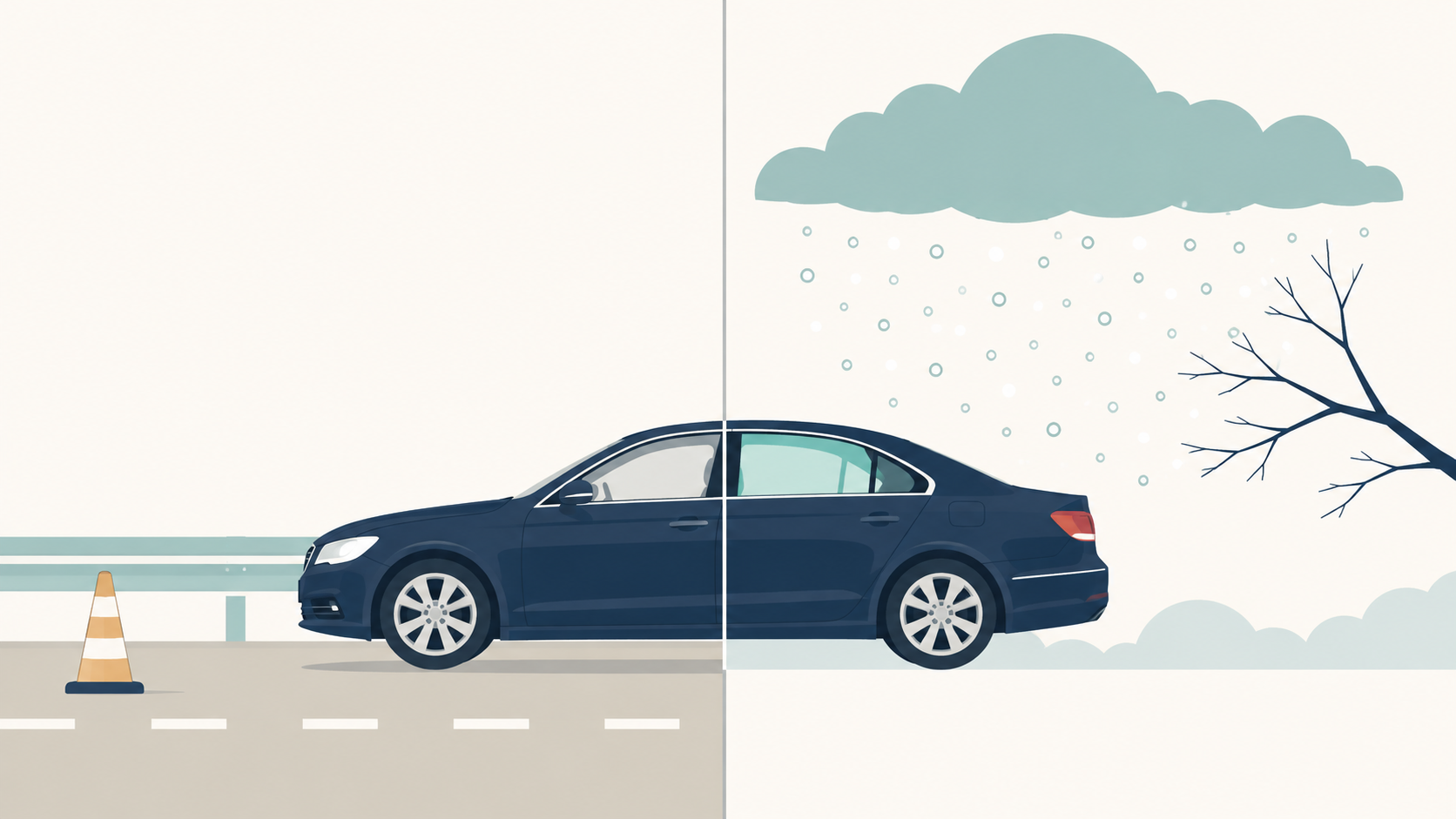
Why the Two Should Not Be Dropped Together
Here is where most guides go vague, and where the practical advice actually lives.
Collision is the expensive half — typically two to four times the cost of comprehensive on the same vehicle. It also covers the risk you have the most control over. If you have a clean record, park in a garage, and could replace the car from savings, collision is the sensible thing to shed first as the car depreciates.
Comprehensive is cheap, and the risks it covers do not decline as your car ages. Hail does not care that your car is nine years old. Neither does a flood, a wildfire, or a thief — and older, common vehicles are frequently the most stolen ones, not the newest. The NICB's 2025 figures put the Hyundai Elantra at the top of the theft list, ahead of anything luxury.
So the usual sequence on a depreciating car is: drop collision first, keep comprehensive longer. The reverse order — which people sometimes choose because comprehensive sounds optional and collision sounds important — leaves you exposed to theft, fire, flood and animal strikes while still paying the expensive premium.
Comprehensive Risk Is Not Static
A useful illustration of why comprehensive is worth keeping is the catalytic converter cycle, which tracks metal prices almost exactly.
Thefts peaked in 2022 at roughly 153,000 converters and more than 64,000 insurance claims. Then rhodium — the metal that makes them worth stealing — collapsed from its early-2021 highs, and thefts fell around 68% by 2024, dropping to roughly 14,000 reported. State Farm's claim volume fell by a similar magnitude.
By early 2026 rhodium had climbed back above $10,000 an ounce, and local figures started moving again: St. Paul, Minnesota recorded thefts roughly tripling during 2025.
An honest caveat, since most articles on this skip it: no national claims data for 2025 or 2026 has been published, so any confident national figure for right now is an extrapolation from local police reports and metal prices, not a count. The directional signal is clear; the magnitude is not.
The point for your policy is simple. The risk comprehensive covers moves with commodity markets, weather patterns and local crime — none of which you control and all of which change faster than your renewal cycle. A converter replacement runs somewhere around $1,500 to $3,000, on a coverage that often costs a couple of hundred dollars a year. If it is stolen and you carry no comprehensive, read what happens after a vehicle theft to see what you are absorbing alone.
The Flood Trap
"Full coverage" is a marketing phrase, not a defined product. It normally means liability plus collision plus comprehensive, but nothing obliges anyone to use it that way.
This matters most after storms. Flood damage to a vehicle is covered under comprehensive — and only under comprehensive. Drivers carrying liability only, or liability plus collision, discover after the water recedes that a written-off car is entirely their loss. Our guide on whether auto insurance covers natural disasters and floods covers the detail, but the headline is that the coverage most people think of as optional is the one that handles the catastrophe.
Setting the Deductibles
The two deductibles are separate, and there is a good reason to set them differently.
Collision: go higher. Moving from $500 to $1,000 cuts a meaningful share of the expensive half of your premium. The condition is that you hold the difference in accessible savings — otherwise you have not reduced cost, you have deferred it to a worse moment. Background in what a deductible really means.
Comprehensive: the premium difference between a low and high deductible here is usually small, because the underlying coverage is cheap. Price both. A lower comprehensive deductible often costs very little and pays off on exactly the claims — glass, theft of parts, hail — where the repair bill sits awkwardly close to a high deductible.
Some insurers offer diminishing deductible programmes that reduce your deductible for each claim-free year. These generally carry an added premium, so compare the annual cost against what it actually removes before enrolling.
One more consideration: comprehensive claims are generally treated as no-fault events and are less likely to surcharge you than collision claims, though multiple claims in a short period still register in the CLUE database and can affect your renewal. See why premiums increase after a claim.
Two Situations
The city car with an asymmetric risk profile
A driver keeps a four-year-old crossover on the street in a large city. Her mileage is low and her driving risk is modest, but her parking situation exposes her to theft, vandalism and parts theft.
Her collision risk is low and she has savings; her comprehensive risk is high and outside her control. So she sets a high collision deductible and takes the lowest comprehensive deductible on offer, having priced both. The premium saving on the collision side more than funds the lower comprehensive deductible.
When a catalytic converter is cut off the car — a repair running to several thousand dollars — she pays a small deductible rather than the whole bill. Her structure matched her actual exposure rather than the default the quote came with.
The work truck past its depreciation curve
A landscaper runs a fifteen-year-old pickup worth about $4,500. Collision and comprehensive together cost $800 a year with a $1,000 deductible, capping any total-loss payout at $3,500.
He drops collision, keeping comprehensive at around $200 a year — because the truck sits outside overnight with tools in it and theft and weather remain live risks. That frees roughly $600 annually, which he puts aside rather than spends.
Two years later he reverses into a post. The $1,200 repair comes out of the $1,200 he has accumulated. The maths worked because he actually saved the difference. Had he spent it, he would simply have been uninsured.
Both are composite illustrations, not accounts of specific individuals. Your own numbers will differ.
How to Decide, in Order
- Is the car financed or leased? Then you keep both. Skip to the deductible section.
- What is it actually worth today? Check current local listings, not a book value from memory.
- What do the two coverages cost separately? Ask for the breakdown; it is on your declarations page and rarely quoted separately.
- Could you replace this car from savings tomorrow? If no, keep the coverage regardless of what the 10% rule says.
- Where does it sleep? Street parking in a hail or theft market argues for keeping comprehensive well past the point where collision stops making sense.
- If you drop something, actually save the difference. This is the step that fails most often.
Frequently Asked Questions
Is hitting a deer collision or comprehensive?
Comprehensive. Animal strikes are classified as environmental events. But if you swerve to avoid the animal and hit something else, it becomes a collision claim.
Does comprehensive cover a cracked windscreen?
Yes. Whether you pay a deductible depends on your state. Florida, Kentucky and South Carolina prohibit a deductible on covered windscreen claims when you carry comprehensive. Arizona, Connecticut, Massachusetts, Minnesota and New York require insurers to offer a zero-deductible glass option that you must elect. Elsewhere your standard deductible applies unless you bought a glass endorsement.
Will a comprehensive claim raise my rates?
Usually not on its own, since these are treated as events outside your control. Frequency still matters — several claims of any type in a short period can affect your renewal, and all claims are recorded in the CLUE database that insurers check when you shop.
Can I buy one without the other?
Yes, unless a lender requires both. Comprehensive-only is a common and sensible structure on an older paid-off car: it is cheap and covers the catastrophic non-driving risks. Collision-only is much rarer and usually a mistake, since it leaves theft, fire, flood and animal strikes uncovered.
What if my car is stolen and I have no comprehensive?
You have no coverage for the loss. Liability and collision do not respond to theft. If the car is financed, you still owe the balance in full.
Does either coverage pay off my loan?
No. Both pay actual cash value only. If you owe more than the car is worth, the difference is yours unless you carry gap coverage.
Are personal belongings stolen from my car covered?
Not by auto insurance. Comprehensive covers the vehicle and its permanently installed parts. Items inside fall under a homeowners or renters policy, subject to that policy's deductible — which is often high enough to make a small claim pointless.
How often should I review this?
Annually, at renewal, alongside the rest of the policy. Depreciation is continuous, but the decision points are not; once a year is enough. Our guide to lowering your car insurance premium covers the wider annual audit.
The Short Version
Collision protects you from your own mistakes and is the expensive half. Comprehensive protects you from everything else and is the cheap half. As a car depreciates, they should come off in that order, not together.
Before you change anything: find out what the two coverages cost separately, find out what the car is actually worth this month, and be honest about whether you could replace it out of savings. Then, if you drop something, put the difference somewhere you will not spend it. That last step is what turns dropping coverage into self-insurance rather than into no insurance.
Sources and Editorial Note
Claim severity figures are industry averages published by ISO, a Verisk business, and reported by the Insurance Information Institute; averages lag by a year or more and vary widely by state and vehicle. Vehicle and component theft figures are from the National Insurance Crime Bureau and insurer disclosures; no national catalytic converter claims data has been published for 2025 or 2026, and figures for those years are drawn from local law enforcement reporting and commodity prices.
State glass rules reflect statutes in force in mid-2026 and are subject to legislative change. Confirm current requirements with your state insurance department, and confirm what you actually hold by reading your policy declarations page rather than relying on the phrase "full coverage".